
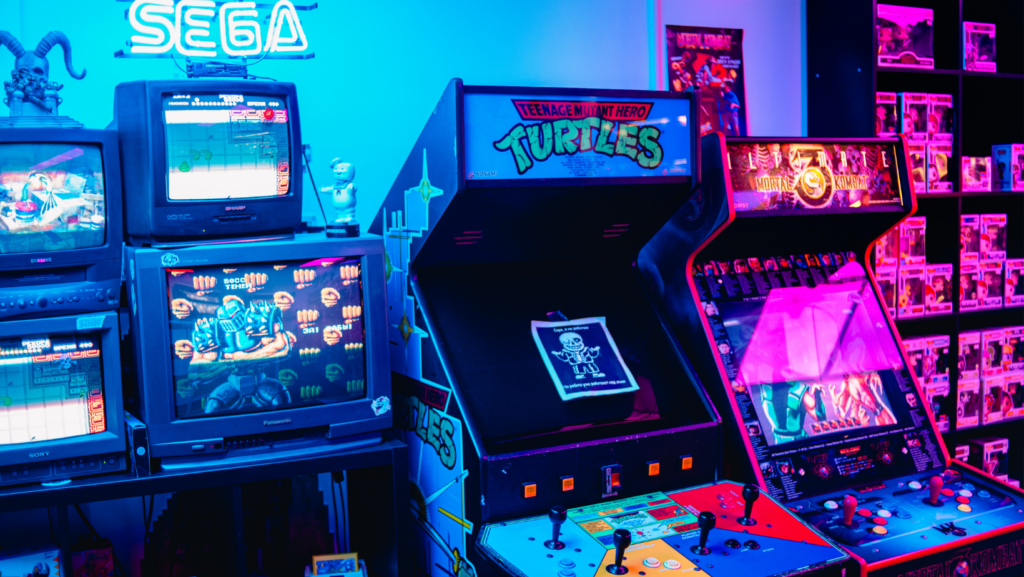
Remember the smell of cheap carpet, the deafening chorus of synthesised bleeps, and the warm glow of CRT monitors? If you grew up in the 90s, the local arcade wasn’t just a place to dump your pocket money—it was a community hub. We stood shoulder-to-shoulder, slapping tokens down on the cabinet marquee to claim the next round in Street Fighter II or Mortal Kombat.
But those sweaty, neon-drenched rooms did more than just provide weekend entertainment. They established the fundamental mechanics of risk, instant gratification, and local competition that define modern entertainment. For grown-up gamers looking for that same thrill of risking a stake for a big win, the spirit of the old coin-op cabinet lives on. This nostalgic crossover heavily influences the digital landscape, especially when looking at the evolution of interactive entertainment and adult gambling in Canada, where players seek out those same high-energy, instant-result thrills from the comfort of home.
Let’s look at how the golden era of arcades built the blueprint for modern play.
The “Insert Coin to Continue” Hook
Arcade game developers in the 90s were masters of human psychology. Unlike home console games that you bought once, arcade cabinets had to justify their real estate on the showroom floor by constantly pulling coins out of your pocket.
They did this through perfectly tuned difficulty curves. The first level made you feel like a god; the second level introduced a harsh reality check; and the third level left you staring at a flashing 10-second countdown timer.
The Testing Experience
I recently fired up an old Teenage Mutant Ninja Turtles: Turtles in Time cabinet at a local retro bar. I gave myself exactly five tokens—the classic high school budget. By the time I hit the Shredder boss fight, my tokens were gone, my palms were sweating, and the urge to dig into my wallet for one more quarter was overwhelming.
That exact tension—the split-second decision to risk a little more to keep the run alive—is the direct ancestor of modern adult gaming mechanics.
The Evolution of the High Score Board
Before global internet leaderboards, the ultimate gaming achievement was securing a three-letter initials spot on a local arcade cabinet. It was the purest form of bragging rights.
|
Era |
Competition Style |
The Reward |
|
1990s Arcade |
Local Cabinet Leaderboard |
Three initials on a CRT screen |
|
Modern Digital |
Global Tournaments & Pools |
Real-world payouts and community status |
According to historical archives on gaming culture maintained by the International Center for the History of Electronic Games, these physical leaderboards were the very first iteration of competitive gaming communities. Today, that competitive drive has evolved. Modern players don’t just want their names on a screen; they want their skills and calculated risks to yield tangible rewards.
The Sensory Jackpot: Sound and Light Design
Why did arcade rooms feel so electric? It wasn’t an accident. Game designers engineered cabinets to create a sensory overload.
- The Attract Mode: Cabinets played loud, flashing loops when no one was playing to pull you in.
- The Sonic Reward: Getting a bonus or clearing a stage triggered high-frequency, celebratory chimes designed to make everyone in the room look at your screen.
- Physical Feedback: Heavy-duty joysticks and clicky microswitch buttons gave a tactile satisfaction that standard controllers couldn’t match.
Modern adult entertainment platforms have mapped these exact triggers. The flashing lights of a bonus round or the satisfying chime of a successful digital spin are built on the exact same audio-visual architecture perfected by Sega and Capcom thirty years ago.
Final Thoughts on the Arcade Legacy
The physical arcades of the 90s may have mostly vanished into the history books, but their DNA is everywhere. The transition from dropping a quarter into a slot to clicking a mouse button is a natural evolution of a culture built on fast-paced decision-making and calculated risks. As we look at how the entertainment industry continues to evolve across North America, the transition back to those core, thrilling mechanics makes perfect sense. We’re all still just kids at heart, looking for that next great rush.
Gambling involves risk. Please play responsibly and only wager what you can afford to lose. If you feel gaming or gambling is becoming a problem, visit BeGambleAware.org.